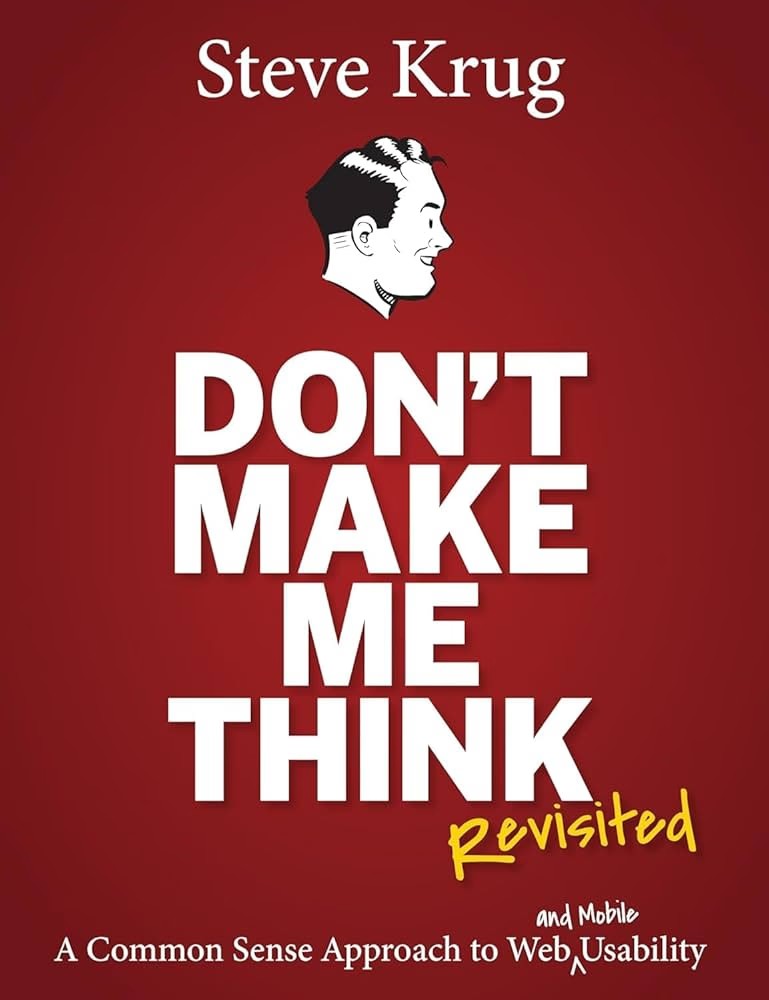
don't make me think
bit of a summary
Don't Make Me Think, by Steve Krug, promotes the idea of consistent usability across different types of web applications. As the title says, good design should not require the user to think too much about any given action or topic. It should require as little thought from the user's input as possible. The book is written for all sorts of designers, from website developers to app interface designers, and aims to inform the reader about how usability should be based on common sense rather than theory and logic. Krug wants to make sure readers understand how regular people actually use a website, and to encourage designers to actively design with that in mind.
steve's main arguement
Steve Krug's main argument is pretty much explained in the title of his book. Don't make me think. As a good designer, you want to ensure that the user needs to think as little as possible in order to create usability that feels second nature. When the user does not need to think, the user's mind takes a backseat, and the flow of the interface is what matters. Krug mentions that if a user ever has to stop to think about what to do next for a navigation, label, or button, the user experience is immediately flawed and has failed from a usability point of view. When people are viewing a webpage, they don't read all the information given to them. They skim, scan, and select what they want to see. The brain picks and chooses items like large words or familiar words to read through the information faster.
another argument
Another main point that Krug goes over within his writing is the importance of knowing where you are on a webpage. The user should always know where they are at all times. The location where you are should be obvious. When you're on a home page, you should know that. When you're on a checkout page, you should also know that. Different webpages should have different feelings and vibes, but all should still have consistent design principles to be uniform.
favorite example
One of my favorite examples of usability that Krug mentions was a crosswalk that had labels on it instead of lines. One side said "Look Right" with an arrow pointing right in order to tell people to look in the direction that cars are coming from. The symbolism of crosswalk lines and traffic lights can be tied into the user experience of web pages as well. When we see a color, we know it's time to walk, and when we see a pattern, we know it's the right place to be to walk. The flow of a website should be just like that. The user should know what they're doing at all times without needing to think about it. By using familiar assets like a hamburger menu or hero heading sections, we can create a sense of familiarity on a website even though the user has never visited it before.
little conclusion
Don't Make Me Think is a guide to second-nature usability and user experience, which all designers should consider when designing a webpage. Something to keep in mind going forward is that there are so many ways to create this same idea without following all the cookie-cutter design assets. It is still possible to be unique and create a design that is second nature to users without using older design principles.